


Search
Blog TOPICAL Index
Follow UPGRADE

   Info about WordGirls

     Member of AWSA

   Info about AWSA


Download "Smitten,"                                                                                                                                  Dawn's Marriage Workbook.


Tuesday
Oct272020

How to Rest from Fear and Worry

When I think of Debbie W. Wilson, the word "clarity" comes to mind. Debbie takes biblical truths and makes them clear and motivating, and helps readers see the Word of God from fresh perspectives. In this Faith UPGRADE, she points to many things we might fear, and one fear we might be overlooking to our detriment.

"Riots, the election, the coronavirus, and the general unrest in our country—not to mention the financial strain on those who still haven’t been able to return to normal work—are enough to strike fear in the most steadfast of heart," Debbie says.

"In addition to this, the normal challenges of life don’t take a vacation when a worldwide pandemic and national upheaval hit." 

Whew! As I (Dawn) read that list of upsets, I felt the tension rise! We really have been through a lot in 2020, haven't we? But we've learned a lot about how to respond too; and Debbie highlights a wonderful choice.

Debbie continues . . . 

The Bible tells us not to fear any of these things (Matt. 6:25-34). It does, however, tell us TO FEAR  something you may be overlooking.

God wants you and me to fear missing His REST!

Notice the warning.

God’s promise of entering his rest still stands, so we ought to tremble with fear that some of you might fail to experience it (Heb. 4:1 NLT).

Say what? Missing God’s rest hardly tops my list of fears. But, according to God’s Word, it should.

So let’s look at how to find rest from our fears.

How Do We Rest from Fear?

Hebrews chapter 4 uses Israel as an example of how we can miss God’s rest.

The rest God offers us is different from the rest He offered Israel.

But both hinge on faith.

God delivered Israel from mighty Pharaoh and promised to lead the nation into the Promised Land. The Promised Land flowed with milk and honey and provided protection.

But Israel listened to their fears instead of heeding God’s promise.

As a result, instead of picking juicy grapes, they ate manna all day—every day—for 40 years as they wandered in circles in the wilderness (Heb. 4:2-3).

If only they had believed God!

Listening to our FAITH will protect us from our fears.

Listening to our FEARS holds us in a wilderness of unrest.

What is rest?

  • In the Old Testament God’s rest was an abundant LAND.
  • In the New Testament God’s rest is an abundant LIFE.

Where do we find rest?

  • In the Old Testament rest was found in a PLACE.
  • In the New Testament rest is found in a PERSON.

Today, fear and worry drive us harder than any Egyptian taskmaster drove the Hebrew slaves. At least taskmasters slept, whereas worry will wake us up in the middle of the night.

Unlike Israel, we don’t have to leave the country, our jobs, or our circumstances to find relief from fear and worry. We only need to run to Jesus (Jn. 10:10Jn. 16:33).

As unbelief kept the children of Israel wandering in the wilderness, so unbelief in our Lord’s daily care keeps us in restless turmoil.

Jesus used the example of a farm yoke to help us understand how our relationship with Him works:

Then Jesus said, ‘Come to me, all of you who are weary and carry heavy burdens, and I will give you rest. Take my yoke upon you. Let me teach you, because I am humble and gentle at heart, and you will find rest for your souls. For my yoke is easy to bear, and the burden I give you is light’ (Matt. 25:28-30 NLT).

Let Jesus teach you... so you can find His rest.

Are you listening to faith or your fears?

Debbie W. Wilson is an experienced Bible teacher and ministry leader. She enjoys equipping others in the areas of relationships, Bible study, Christian living, and discipleship. Known for her fresh insights and ability to make the Bible come alive, Debbie uses Spirit-filled encouragement to inspire her readers to trust God with their lives. Drawing from Hebrews 11, her latest book, Little Faith, Big God, shows readers how to live well and finish strong. Debbie enjoys dark chocolate, a good mystery, and the antics of her two standard poodles. Find free resources and connect with Debbie at debbieWwilson.com.

Tuesday
Oct202020

"Did You Hear?"—Conquering the Gossip Addiction

In this Habits UPGRADE, Dawn encourages Christians to avoid gossipers and conquer the unseemly habit in themselves.

It has been estimated that 80% of our conversations are spent on discussing other people and their habits. In other words, we gossip. A lot.

While that seems high to me—I was thinking maybe 60%—it's still not something a Christian should ever do.

Gossiping is the act of spreading a rumor, or sharing idle talk—sometimes private information—to others in a personal, sensational and intimate way. The act may be malicious, or simply foolish; but God calls it sinful. A "gossiper" habitually spreads "juice" gossip.

Other similar activities include "talebearing," "whispering," giving an ill or "evil report," and slandering.

It's no small thing.

The Old Testament says, "He who goes about as a talebearer reveals secrets, but he who is trustworthy conceals a matter" and "He who goes about as a slanderer reveals secrets, therefore do not associate with a gossip" (Proverbs 11:13; 20:19).

Slanderers are called fools (Proverbs 10:18), and whisperers hurt and destroy others (Proverbs 18:8).

Have you ever noticed how gossip is usually passed on in whispers? We don't want others to know we're sharing "secrets." Whispering creates conflict, so we need to be careful not to add fuel to the flames (Proverbs 26:20).

That's all Old Testament truth, but the New Testament is even more pointed.

The New Testament word for gossipers is also "whisperers," but also "babbler." Paul said the pagans were gossipers (Romans 1:29), but even those in the church could arrogantly slander others and gossip (2 Corinthians 12:20-21)—two of the sins that grieved the Apostle Paul.

Gossiping and whispering was a problem for idle young widows, Paul said (1 Timothy 5:13). He called them "busybodies." He instructed women not to be "malicious gossips" (1 Timothy 3:11). 

Perhaps people who gossip think it's justified because the information is true; but gossip is sharing information that shouldn't be shared with people who are not part of the problem or the solution—even if it is the truth.

Pride may also be involved. We can delight in sharing something "confidentially" that we know others  might not know.

Also, our "Did you hear?" information may not be loving or kind.

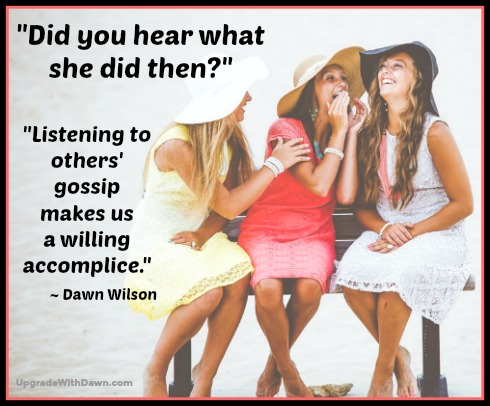
Listening to others' gossip makes us a willing accomplice (Proverbs 17:4), and it contaminates our inner life as well.

If we wouldn't say it directly to the person who is the subject of the information, we shouldn't ever share it with others. (Maybe there's one exception—if that person is in direct danger.)

So, maybe that 80% statistic is something we need to think about.

As I've pondered this, I thought of some hard questions Christ-followers probably need to ask themselves:

  1. Am I driven to tell others' "secrets"? Am I addicted to gossip—compulsive about it?
  2. Are people avoiding telling me things—maybe because they wonder if I will "pass it along" to others?
  3. When have I justified my whispering?
  4. Do I share "prayer requests" that are really gossip?
  5. Do people often approach me to share "juicy" information? What does that say about me?
  6. Have I ever betrayed a confidence in my sharing?
  7. How do I know the difference between good sharing vs. gossip? (Is there really a "fine line"? If so, what is it?)
  8. What do I feel like after I share information about others?
  9. Is God pleased by what I share with others?
  10. Is this a destructive habit I need to break?

The Bible warns repeatedly about gossip, so God thinks it is serious.

I need to take gossip as seriously as God does!

Sometimes we get caught up in a gossip session and aren't sure what to do. Like the old proverb, "We can't avoid the bird flying over our head, but we can prevent him from building a nest in our hair," there are a number of steps we can take to cut a gossip session short.

Five Steps to Take in Dealing with Gossipers

1. Confront Gossipers

Stand up to people who gossip by saying you don't want to know about what they're trying to tell you. Be polite yet firm. It's not refusing to participate, it's holding others accountable. Jesus holds high value on our words (Matthew 12:36-37).

2. Change the Subject

Sometimes we can distract people from gossiping by changing the subject. Remember Ephesians 4:29 and consider whether the words are "unwholesome" or helpful in building people up and encouraging them.

3. Challenge the Information

Pieces of information may be missing or incorrect. Sometimes by asking questions, we can figure out a problem in a shared story, or see how the gossip is unreliable. We can correct untruths and give those being attacked the benefit of the doubt until there is more proof. We may not have all the facts, or understand the motives of their hearts (1 Corinthians 2:11).

In the case of serious sin, there are biblical principles for confronting this through church discipline (Matthew 18:15-17; 1 Corinthians 5:1-13)—and it does not include gossip!

4. Choose Positive Conversations

Think about things that are excellent and praiseworthy (Philippians 4:8).

Consider that those being gossiped about also have positive qualities. Try to focus on and express those to others.

5. Call on the Lord

With all the gossiping going on, a good practice is to turn gossip targets into the objects of our prayers. Isn't it better to talk to the Lord instead of other people about the possible failings and negative stories we hear? We are to pray about everything (Philippians 4:6), and that includes the "whispers" of gossip.

We can ask the Holy Spirit to intervene if there is an actual problem, to overcome the attacks on good reputations, and to bless those who are persecuted through gossip. God wants us to be peacemakers (Matthew 5:9), and that begins with sincere prayers.

And if YOU have a Gossip Addiction, use these five steps on yourself!

  • Confront the unwise use of your tongue.
  • Change your thinking and consider ways to build others up.
  • Challenge the information—be intentional about asking questions to discover truth before you jump into a gossip session.
  • Choose transformed thinking (Romans 12:2) rather than the easy way of gossip.
  • Call out to God for wisdom and the Holy Spirit for help in overcoming this sinful habit. You are already an overcomer in Christ (1 Corinthians 15:57). Lay hold of that power.

Instead of "Did you hear?," ask, "How can I get the victory today, Lord?"

Dawn Wilson, founder and President of Heart Choices Today, is a speaker and author, and the creator the blog, Upgrade with Dawn. She is a contracted researcher/reviewer for women's teacher and revivalist, Nancy DeMoss Wolgemuth, at Revive Our Hearts, a blogger at TrueWoman.com, writes wiki-type posts at  Christianity.com, and is a regular columnist at Crosswalk.com. She and her husband Bob live in sunny Southern California, and Dawn has traveled with Him in Pacesetter Global Outreach. They have two grown, married sons, three granddaughters and a rascally maltipoo, Roscoe.

Graphic adapted, courtesy of Ben White at Unsplash.

Thursday
Oct152020

Finding Peace When Regret Cripples Your Heart

Dianne Barker is a positive author with a caring heart. In this Biblical Perspective UPGRADE, she reminds us where our peace comes from when our hearts are filled with regrets.

Dianne asks, "Are you looking back on what appears to be a colossal failure?"

I (Dawn) think we all have them—regrets about our failures. But we don't have to let regrets settle into our hearts. God made a way to confident peace, and Dianne helps us understand how that can change us.

Dianne continues . . .

Looking back on failure thrusts me into a reflective mood:

  • wondering where I messed up,
  • how I could have made better decisions, and
  • what else I could have done to get the desired result.

The cliché hindsight is 20/20 is on target.

Sadly, we don’t have hindsight when we need itBEFORE the colossal failure.

When it does show up, we beat and blame ourselves for not handling matters better, crying, "If only!"

A friend’s wise words helped me move beyond crippling regret.

I had arrived at our Bible study feeling discouraged and defeated after giving an angry response to someone I loved. Now my friend and I would teach other women about the Christ-filled life.

Feeling like a failure, I shared the situation with my co-leader, Amy, a precious and godly young woman who loved me unconditionally. 

She knew my angry response was out of character and that I would make amends. But at this moment, I needed to move beyond the incident and focus on the lesson.

With eyes communicating love and concern, she said,

“'Forgetting what lies behind and straining forward to what lies ahead.' If something happened five minutes ago, it’s behind.”

Learning to apply Philippians 3:13 in such a practical way changed me.

Our amazing minds do not forget, but we can choose to put a matter out of mind.

The top two reasons to forget the past: 

  • It wasn’t very good.
  • It’s unchangeable.

Why do we continue thinking about a disappointment that caused hurt? It’s past… unchangeable.

If we don’t put it out of mind, failure will rob our peace and joy going forward.

Maybe you had a colossal failure in a relationship. Maybe you made a devastating personal choice.

Here's how I've learned to deal with regrets:

1. Run to Jesus and confess the failure.

2. Accept His forgiveness.

3. Seek His wisdom and go in His strength to make amends, if amends are required. (Sometimes the issue is mine only).

4. Choose to put the incident out of mind and go forward giving praise to the Lord.

Our Enemy loves to berate us, reminding us of failure and pouring on regret.

Friend, it is past! Forgiven!

Actively trust in God's forgiveness, release the past to His grace, and surrender your life to walk in obedience.

King David had a colossal failure. Remember the Bathsheba-Uriah incident? He suffered unthinkable consequences for his poor judgment, but he confessed and received God’s forgiveness and blessing.

Let 1 Kings 15:5 encourage you:

“because David did what was right in the eyes of the Lord and did not turn aside from anything that he commanded him all the days of his life, except in the matter of Uriah the Hittite.” 

Is there a colossal failure you need to get past? When the Enemy pours on regret, how can embracing what God's Word says about intentionally "forgetting" your past—your regrets—give you peace?

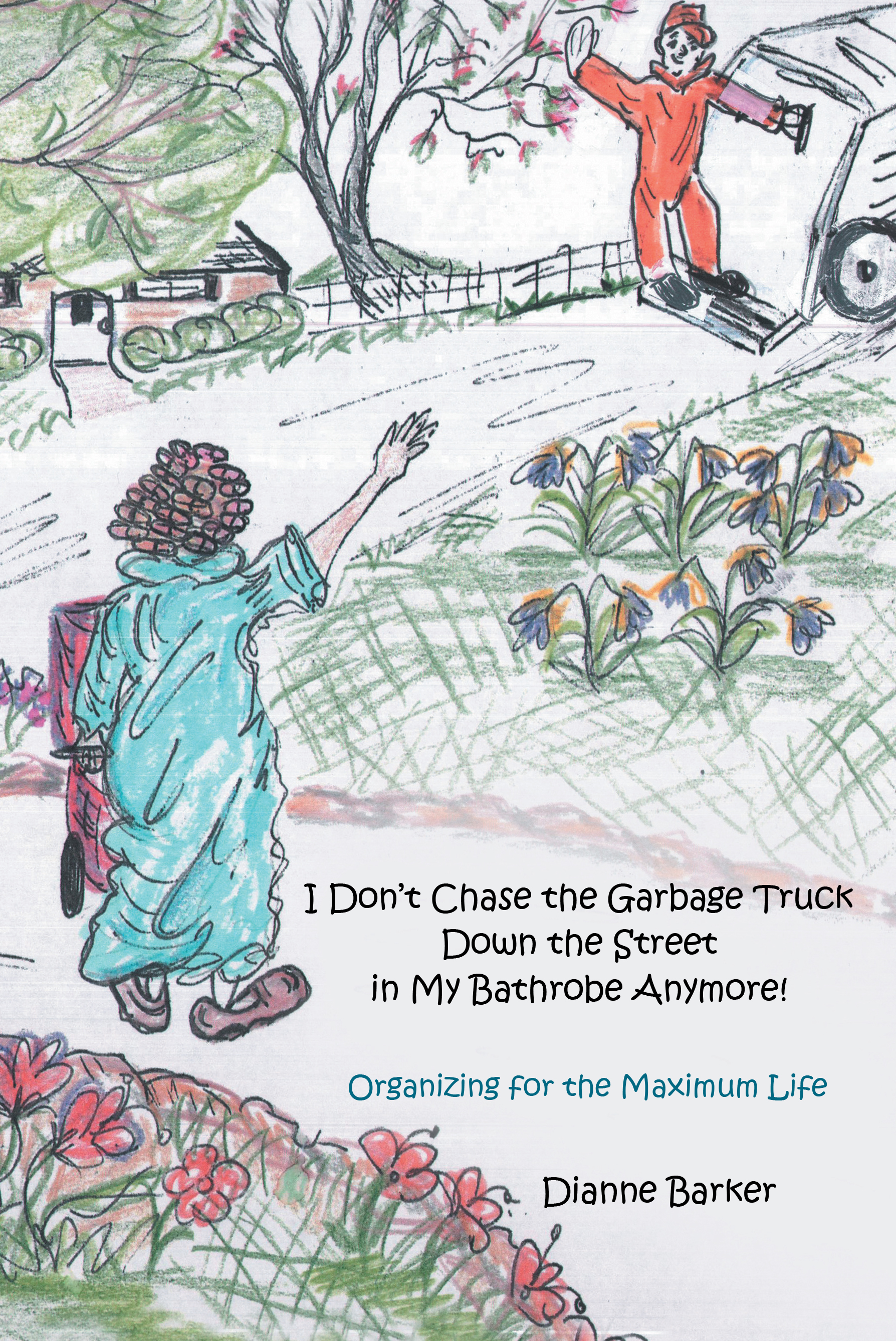
Dianne Barker is a speaker, radio host, and author of 11 books, including the best-selling Twice Pardoned and award-winning I Don’t Chase the Garbage Truck Down the Street in My Bathrobe Anymore! Organizing for the Maximum Life. She’s a member of Advanced Writers and Speakers Association, Christian Authors Network, and Word Weavers International. Visit her blog for more information. www.diannebarker.com.

Graphic adapted, courtesy of Foundry Co at Pixabay.

Thursday
Oct082020

If You Can't Be Kind, Be Quiet

Author Deb DeArmond focuses on strengthening relationship. In this Communication UPGRADE, she suggests we check our words before they cause damage.

"Did you know each year there is a National Say Something Nice Day? It was new to me," Deb says, "and made me think of my mama. It would have made her happy."

My (Dawn's) mom knew I was a "word person." Perhaps that's why she often encouraged me to be careful how I used words. It sounds like Deb's mom was a lot like mine!

 Deb continues . . .

Mama often shared her belief that “If you can’t say something nice, say nothing at all.” It wasn’t just a slogan; she lived it every day.

I never heard her say a mean or critical word about a single person, with the exception of her second cousin Hattie, who deserved it according to Mama.

“That girl had a mean streak.”

She once bit my mother hard enough to draw blood, so I think it’s a valid observation. But with this one exception, Mom was a gentle and generous soul.

She looked for the goodness in every person and as a result, she almost always found it.

Easier said than done.

If you have family, you already know this can be tough duty. Especially in the face of what we often call at my house, “an intense moment of fellowship.”

If you overheard the discussion, you might think we’re engaged in an argument. Some may claim it’s a matter of semantics since the two are quite similar. We prefer to position it in a more friendly way.

Definition aside, when it gets heated, something nice is not always the first phrase that occurs to us or rolls off the tongue.

And the tongue is often the problem with conflict, isn’t it?

The scripture gives us that heads up:

Indeed, we all make many mistakes. For if we could control our tongues, we would be perfect and could also control ourselves in every other way (James 3:2 NLT).

Every other way?

You mean, if I could manage my mouth, I’d also be able to resist the call of Cappuccino ice cream? Now there’s some motivation!

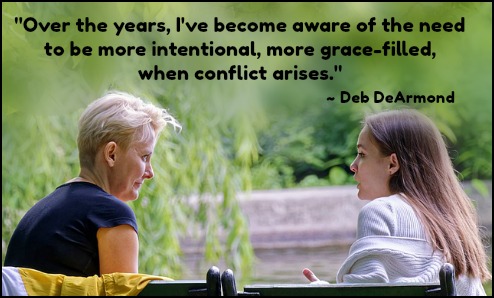
Over the years, I’ve become aware of the need to be more intentional, more grace-filled, when conflict arises.

God's Spirit has been persistent to point out missed opportunities, little slips, and major mishaps of the mouth.

Gentle words are a tree of life; a deceitful tongue crushes the spirit (Proverbs 15:4 NLT).

I’m working on it.

Just remember, we do have an enemy—but our friends or loved ones are not our adversary.

God expects us to speak the truth in love when we’d prefer to give someone a piece of our mind.

Making our point cannot be more important than making our Heavenly Father happy.

Today, identify an opportunity to say something nice. Find something genuine, not manufactured, and smile when you say it.

If you want to make a super-powerful positive impression—write it down. Slip a note in his pocket, the kids’ lunchbox, or tuck a card in her purse.

A discovery of a compliment or acknowledgement is a prize, and when it’s unexpected, it’s so much sweeter. It just might make your someone’s day.

And it will make your mama so proud!

Take a quick inventory

Be honest with yourself.

  • How often do you walk away regretful of a harsh or unkind word you’ve spoken? What pulls you into that behavior?
  • How are relationships impacted when the communication—and your best intentions—get away from you?
  • Identify one strategy to remind you to be quiet if you're struggling to be kind—perhaps a simple prayer or scripture before a conversation that might be difficult.

We can't fix what we don't acknowledge. Enhance your self-awareness and use your answers to set a new course!

Proverbs 15:4 reminds us,

Gentle words are a tree of life; a deceitful tongue crushes the spirit (NLT).

If you can't be kind, be quiet.

What is the strategy you identified to remind you to be quiet if you struggle to be kind? Ask God for wisdom, and don't give up. Your relationships are worth the effort.

Deb DeArmond is the author of Related by Chance, Family by Choice, I Choose You Today, and Don’t Go to Bed Angry. Stay Up and Fight! All three books focus on relationship dynamics, communication, and conflict resolution. For more information about Deb and her ministry, visit her website.

Graphic adapted, courtesy of Candid-Shots at Pixabay.


Thursday
Oct012020

Too Soon Old und Too Late Shmart

In this Wisdom UPGRADE, Dawn Wilson encourages the pursuit of wisdomas early as possible!

Today is my birthday, and I've been thinking a lot about aging and what it means. As I meditated on God's purposes in my life going forward, a favorite proverb came to mind:

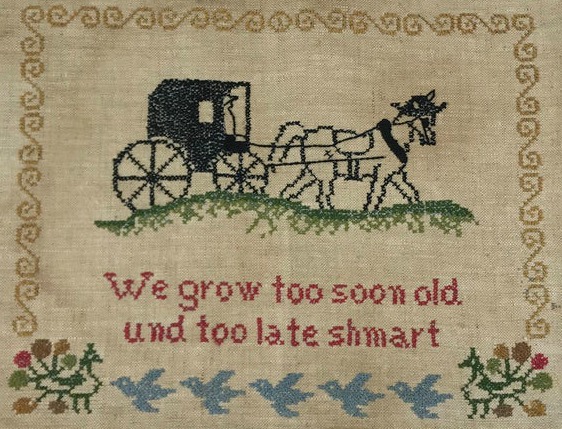
"We grow too soon old und too late shmart."

It is sometimes attributed to Chinese, Japanese, Swedish, Danish, and Jewish sources, but usually, it's considered a "Pennsylvania Dutch" proverb—often seen on their pottery and souvenirs. My German-Dutch grandparents on my dad's side used to talk about being "shmart."

I went to college in Pennsylvania, about two hours north of Lancaster County—sometimes known as "Amish Country." As I understand it, the Pennsylvania Dutch aren't necessarily Amish, but the Amish are Pennsylvania Dutch—but they're not really Dutch. They're German!

The Pennsylvania "Deutsch" (or Pennsylvania Germans) are the descendants of German-speaking immigrants.

I toured Amish Country and had fun learning Pennsylvania Dutch expressions during my two years at college. I remember these two:

"Eat yourself full."

"Outen the lights."

I used to say those two phrases all the time.

But it was their proverbs that captured my thoughts.

  • Good marriage counsel for women: "Kissin' wears out—cookin' don't."
  • Good marriage counsel for men: "A plump wife and a big barn never did any man any harm."

As I noted, my favorite proverb was "We grow too soon old und too late shmart," because I was at college and focusing on getting smart!

I should have focused on getting wise.  

Smart and wise are not the same thing.

My years of schooling taught me many things. I love to read non-fiction, and I remember that as a young girl, I devoured my Grandma Parks' "Lincoln Library" in her attic. This early encyclopedia-type resource encouraged my intellectual curiosity. I felt I couldn't learn enough! And I learned a lot of "facts."

But now, I wish I'd pursued wisdom at that young age.

Not that being smart is bad. In fact, smartness isn't just the facts we learn in school. "Street smarts" is a thing. And people are gifted with all kinds of intelligences.

One source says there are nine types of intelligence.

Wisdom, however, goes beyond intelligence, and the Bible rates it more valuable than "smartness."

  • A person can have an extremely high IQ and still be counted a fool.
  • A person can be a genius and have no sense.
  • Some intellectually-superior people have even been considered evil. (Hitler was thought to be a genius in certain respects.)
  • On the other hand, those who might be considered unlearned or slow can be truly wise.

The words "wise" and "wisdom" appear in scripture more than 450 times, so it's something the Lord wants us to consider.

The writer of Proverbs described four animals as "wise" (Proverbs 30:24-28) to illustrate the practical application of wisdom for us.

Biblical wisdom is about understanding how to behave and choose correctly in different circumstances. It's also about knowing how to complete God-given tasks well.

I think my version of that old German proverb might be: "Too soon old and too late WISE!"

There are people who face eternity with very little wisdom, because they failed to avail themselves of the wisdom that comes from God.

But as long as we're alive, we don't have to get stuck there. Our IQ might stay the same until we die, but we can always increase in wisdom—to mature and go beyond the "milk" of the Word to "meat" (Job 32:7; Hebrews 5:12).

Wisdom is so needed today.

  • Wisdom is something we need to teach our children.
  • Wisdom is so needed in our churches—what we need to hear proclaimed from our pulpits.
  • Wisdom is what we need to manifest in our communities to the glory of God.

Here are some biblical facts about Wisdom.

  1. Wisdom for living begins with knowing God and having reverence and healthy "fear" of Him (Proverbs 9:10). His Word makes even simple people wise (Psalm 19:7b). We need to choose wisdom and learn from it.
  2. When we choose wisdom, we'll soon discover so many blessings from its presence in our lives (Proverbs 8:12-21; 32-36; 24:14). Wisdom is better than fine gold! (Proverbs 16:16)
  3. There has been much talk in this year during the Covid-19 pandemic of what is "essential." The Bible says wisdom is essential, because if we fail to find and apply it, we "love death" (Proverbs 8:36).
  4. One of the qualities of God is wisdom (Psalm 104:24; Proverbs 3:19; Job 12:13; Daniel 2:20; Romans 16:27); and Paul said "all the treasures of wisdom and knowledge" are found in Christ (Colossians 2:2-3).
  5. We can ask for His wisdom—wisdom from above (James 1:5). He is the giver of wisdom (Proverbs 2:6; Ephesians 1:17).

Today, my birthday, I am recommiting to a scripture the Lord reminded me about last year when I faced a diagnosis of Multiple Myeloma.

In those early days, I didn't know how long I'd live. It was a hard concept to think about. Then I read Psalm 90:12.

So teach us to number our days that we may get a heart of wisdom.

A heart of wisdom. That's what I wanted more than anything. It became a precious thought, replacing my concerns about the length of my life.

Later, the Lord gave me another verse:

Look carefully then how you walk, not as unwise but as wise, making the best use of the time, because the days are evil (Ephesians 5:15-16).

If ever we needed wisdom, it is in these chaotic days. We need more than human intelligence, because God's thoughts and ways are not our thoughts and ways (Isaiah 55:8-9). We desperately need His perfect wisdom and perspective.

Wisdom sets people apart from people who are merely "smart."

Two of Jesus' disciples, Peter and John, were courageous in sharing the Gospel. People around them wondered at them, noting they were "unschooled and ordinary men," but what a difference being with Jesus made in their lives (Acts 4:13).

Spending time with the Lord and His Word will give us courage, but also wisdom. He IS our wisdom from God (1 Corinthians 1:30).

So I'm older today and maybe a little smarter; but my joy is to know wisdom can increase as I allow God's Word to transform my thinking (Romans 12:2) and help me please the Lord.

Can you pray this with me?

Lord, I want a heart of wisdom!

Are you wise? How can your wisdom increase?

Dawn Wilson, founder and President of Heart Choices Today, is a speaker and author, and the creator the blog, Upgrade with Dawn. She is a contracted researcher/reviewer for women's teacher and revivalist, Nancy DeMoss Wolgemuth, at Revive Our Hearts, a blogger at TrueWoman.com, writes wiki-type posts at  Christianity.com, and is a regular columnist at Crosswalk.com. She and her husband Bob live in sunny Southern California, and Dawn has traveled with Him in Pacesetter Global Outreach. They have two grown, married sons, three granddaughters and a rascally maltipoo, Roscoe.

Graphic of cross-stitched piece from Unique Treasures PA, on Etsy.