


Search
Blog TOPICAL Index
Follow UPGRADE

   Info about WordGirls

     Member of AWSA

   Info about AWSA


Download "Smitten,"                                                                                                                                  Dawn's Marriage Workbook.


Tuesday
Jul212020

Life in the Age of Listening and Learning

Julie Sanders is globally-minded, but she shares her wisdom with individuals, always pointing them to the Word of God. In this Communication UPGRADE, Julie encourages us to listen well, and be careful where we're listening.

"The need for understanding runs like a common thread through the noise of 2020," Julie says.

"Have you heard commitments to listening and learning? Have you expressed this intent?"

When I (Dawn) hear people shouting at one another during these chaotic times, I wonder, "Is anyone even listening? Or is everyone simply pushing their own agenda?

What would happen if we would learn to listen and learn?

Julie continues . . .

LEANING IN with openness to listen and learn can be wise. In loud days, it can also be complicated.

With intense events demanding global attention, no one escapes hearing something or someone.

Made in God’s image, the first Listener, we learn in His Word how to discern who and what we give a hearing.

1. Our Maker Listens

All people reflect God’s image, so His example as a listener matters. He doesn’t have to listen to the lowly, but He does.

He promised, “I will listen to you” (Jeremiah 29:12).

God assures us He listens.

“The eyes of the Lord are on the righteous, and his ears are attentive to their cry,” (Psalm 34:15). He gives attention to our words, even our cries. It’s a behavior we give thanks for.

2. We’re Made for Listening

Out of gratitude for God’s heart to hear us, we can learn to grow our listening skills. 

Instead, we’re often inclined to answer before leaning in.

God calls us out for what we are in those moments: disgraced.

“To answer before listening—that is folly and shame” (Proverbs 18:13).

Join a group in spewing words without humble listening, and we become part of a disgraceful group.

No one is exempt from the need to hear attentively with a heart to understand. 

“Everyone should be quick to listen, slow to speak and slow to become angry” (James 1:19b).

When we listen, we learn. If we only hear without godly attentiveness, we miss out on learning.

If we shut out godly instruction, Proverbs warns that we stray (Proverbs 19:20, 27).

3. We Benefit from Hearing

When we hear and act on messages aligning with God’s truth, we’re blessed.

“Blessed rather are those who hear the word of God and obey it” (Luke 11:28).

We are blessed when we remember what God says and do it (James 1:25). We’re like a wise man who builds his life on a rock (Matthew 7:24)—so if life feels shaky, it may be due to the voices we’re listening to.

4. Deception Speaks

Fallen voices speak fallen messages.

This is the challenge in a fallen world, discerning WHERE to lean in and listen. We can’t afford to be lazy listeners learning from peddlers of their own passions apart from God’s truth.

Jeremiah 23:16-17 warns listeners about hearing messages that don’t align with God’s truth. If listeners heed those voices, the imaginations of people “delude” them with “false hopes.”

Believing deceivers leads to losing God’s promised blessings.  

We can’t listen to every voice in the noisy now.

We can’t afford to let deceitful voices be those we listen to.

“Do not merely listen to the word, and so deceive yourselves. Do what it says” (James 1:22). To know how to navigate these days, we must protect time and space to lean in to voices of truth.

The noisy now grows louder each day. Let’s lean in as listeners learning to see these days in God’s ways.

Where are you listening in these loud times? Who are you listening to and learning from? Is there a voice you need to silence or one to amplify? Plan for some quiet time so you can hear.

Julie Sanders loves uplifting leaders globally. She finds joy in helping women listen and learn cross-culturally from one another and, most of all, from God’s truth for life in every land. She’s the author of The ABCs of Praying for Students. Julie calls the Northwest home and writes from her online base at juliesanders.org.

Graphic adapted, courtesy of Jon Wisbey at FreeImages.com.

Thursday
Jul162020

Quarantine, Cameras and Accountability

Kolleen Lucariello—winsome and wise—speaks truth into women's lives while challenging them to live a joy-filled life. In this Accountability UPGRADE, she encourages us to accept responsibility and move closer to our identity in the Lord.Kolleen says, “I realized the COVID-19 crisis was beginning to cause a Kolleen crisis when I detected fear and frustration were expanding through loneliness, boredom and inactivity.”

I (Dawn) have had a few "Dawn crises" over my lifetime, and they usually came when I tried to face tough things alone or make excuses for my failures. Not a good idea, as Kolleen explains.

Kolleen continues . . .

When the quarantine took over daily life, I was invited to join a ZOOM exercise class led by my friend Chrissy’s daughter. Having never experienced a class like this one, and craving interaction with others, I decided to give it a try.

The first class was …well… it wasn’t exactly an attractive display of technique, as I became painfully aware of my lack of ability. 

Truth-be-told, I was a bit intimidated by those in her class who were far more advanced than I. When Chrissy told me she participates with her camera “off,” a great sense of relief washed over me.

When I signed in to the next class, before one stretch began, I turned the camera to “off” and felt the freedom to do my thing.

After a few weeks of participation, I began to recognize a poor pattern had developed in my effort within the class.

While I could see Rachel, the instructor, she could not see me.

I was hidden behind my photo on her screen rather than a live-video feed. There were moments when, while she was encouraging her class to “hold it for just four more counts,” I was allowing excuses to fill my mind for why I was unable to do what she was asking.

I can tell you, every excuse was valid:

  • My hands and wrists hurt immensely.
  • I am not as fit as I used to be, nor am I as strong as I once was.
  • My legs shake.
  • My core is weak.
  • When she asks me to pull my belly button in, it’s nearly impossible for me to convince my rebellious belly button to surrender itself to my effort.
  • The hour I spend in class is difficult.
  • It is uncomfortable.
  • It also requires effort and a willingness to push through all discomfort. Some days I don’t.

During one particularly arduous class, I laid on the floor for a good portion of the leg workout listening to my body expound on the reasons for its protests. The excuses for its inability to commit to the workout seemed reasonable.

Finally, the discomfort within my body held a greater sway over any disappointment I would feel by quitting.

With my camera off, no one could see what I was—or was not—doing.

As I lay on the floor, listening rather than doing, I became aware of how susceptible we become to old habits and mindsets when accountability is lacking.

Without the accountability of Rachel being able to see me, it became quite easy for me to give a less-than-my-best-effort. She encourages the class to “get lower” or “push through the discomfort,” confirming to us that she understands our legs are shaking and the work is hard, but she’s pushing us to not give up because she recognizes growth, strength and change come through persistent effort.  

With accountability defined by Merriam-Webster as “an obligation or willingness to accept responsibility or to account for one's actions,” it seems impossible to deny accountability, when used correctly, is a gift to us—prompting change and growth. After all, don’t we have an obligation to accept responsibility for our own actions?

Accountability brings upgrade when we find ourselves willing to allow a trusted friend or mentor to help us see areas in our life where we’ve permitted excuses and blame to keep us from accepting responsibility.

How Does Accountability Help Us?

1. Our faith takes on a new form of growth when we become accountable to one another.

This means we allow someone to see what is behind the camera.

While it is tempting to share only the highlight reel of our lives rather than expose our difficulties, this creates an illusion that “all is well” when in reality, it might not be.

2. Our faith is strengthened when we acknowledge our need to pull from the wisdom God has put within others.

Solomon wrote,

“Though good advice lies deep within the heart, a person with understanding will draw it out” (Proverbs 20:5 NLT).

When you perceive the wisdom of God in someone—draw it out!

Listen when they say, “I understand your world is shaking right now” or “I know this hard, but you can do it!”

3. Accountability stands guard against the bad habits that continue to haunt us and then shame us, but it requires courage.

Accepting responsibility truly is a gift that moves us closer to our true identity in Christ.

Proverbs 19:20 says,

“Get all the advice and instruction you can, so you will be wise the rest of your life” (NLT).

It’s time for me to turn the camera on! This will allow Rachel to see where I am weak and struggling—right now—but will also allow her to point out where she sees strength and growth.

What about you? Is your camera set to off? Perhaps you’d find more freedom if it was on.

Kolleen Lucariello, #TheABCGirl, is the author of the devotional book, The ABC's of Who God Says I Am; and as a speaker, she speaks into women's lives "one letter at a time." Kolleen and her high school sweetheart, Pat, reside in Central New York. She's a mother of three married children and Mimi to six incredible grandkids. For more information about Kolleen, visit her website.

Graphic adapted, courtesy of StockSnap at Pixabay.

Tuesday
Jul142020

The Great Divide

Kathy Carlton Willis is one of the most faithfully joyous women I know. In the midst of difficult situations, she looks for the God of joy, peace and wisdom. In this Relationships UPGRADE, she encourages Christ-followers to engage with our growing cultural divides through the powerful grace of God pouring through our lives.

“Now more than ever, I’m feeling the pressure of the great divide all around me,” Kathy says.

“There are so many issues where people are taking sides, and they assume I’m on their side or they judge me if they assume I’m on the other side. They do this, without even asking my view or my reasons!”

I (Dawn) can relate. I squirm in discomfort when there is conflict. And it seems to be everywhere these days!

Kathy continues . . .

To be honest, I’m more of a “Why can’t we all just get along?” kind of gal. I don’t want there to be sides. We can be mature enough to respect people who have a different viewpoint than us.

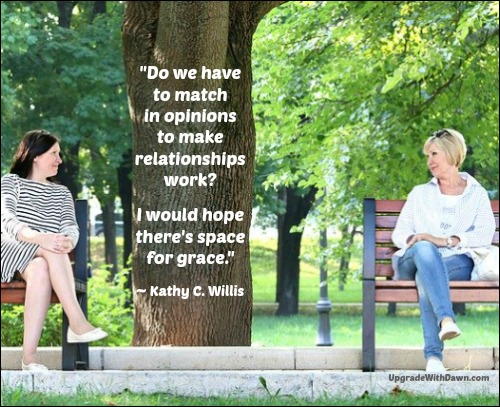
Do we have to match in opinions to make relationships work? I would hope there’s space for grace.

There are so many differing opinions these days:

  • Masks or no masks?
  • Self-isolating/social-distancing or back to normal?
  • Republican or Democrat?
  • All Lives Matters or Black Lives Matter?
  • Homeschooling or public education?
  • Big churches, small churches or home church?
  • Technology-centric or simple-focus?

What do I do when people make a wrong assumption about me? Or worse, they judge me because of that assumption?

What can you do?

Don’t label fear in someone unless you know their brave story.

Be devoted to one another with [authentic] brotherly affection [as members of one family], give preference to one another in honor (Romans 12:10 AMP).

How to Engage with Grace, not Disgrace

1. Ask yourself if the battle is more important than the relationship.

2. Will the issue matter five years from now? If it’s temporary, you can get past it.

3. Start conversations by acknowledging how you value the other person.

4. Tell stories rather than discussing facts. Your experience is more important to the other party than something you’ve read.

5. Resist stirring the pot by making divisive statements.

6. Ask them for permission to discuss it before bringing up subjects that divide.

7. Decide in advance what you will do if the conversation gets uncomfortable.

8. Don’t drag others into the dispute. No one likes being put in the middle of someone else’s battle.

9. Avoid making personal accusations to make your point. In debate, we were taught you can tell when a side is losing when they start to attack the person rather than debate the issue.

10. Don’t make it your life mission to change people’s minds on things that don’t matter for eternity.

So I, the prisoner for the Lord, appeal to you to live a life worthy of the calling to which you have been called

[that is, to live a life that exhibits godly character, moral courage, personal integrity, and mature behavior—a life that expresses gratitude to God for your salvation], with all humility [forsaking self-righteousness], and gentleness [maintaining self-control], with patience, bearing with one another [a]in [unselfish] love. 

Make every effort to keep the oneness of the Spirit in the bond of peace [each individual working together to make the whole successful] (Ephesians 4:1-3 AMP).

Some things I’m doing:

  • I’m listening more and talking less.
  • I’m evaluating why certain opinions matter so much to me that I’d be willing to hurt a relationship to be right. The answer is, nothing matters more to me than people.
  • I ask Jesus to show me the hearts of others as he sees them. Usually he shows me they are hurting, not hurting me.
  • I’m learning to appreciate diversity. Differences can be beautiful, like a garden filled with various flowers.
  • I’m finding common ground rather than fixating on our differences.

Today what will you do to be part of the BRIDGE and not part of the DIVIDE?

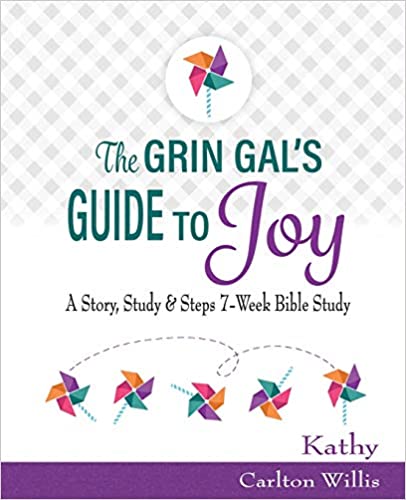
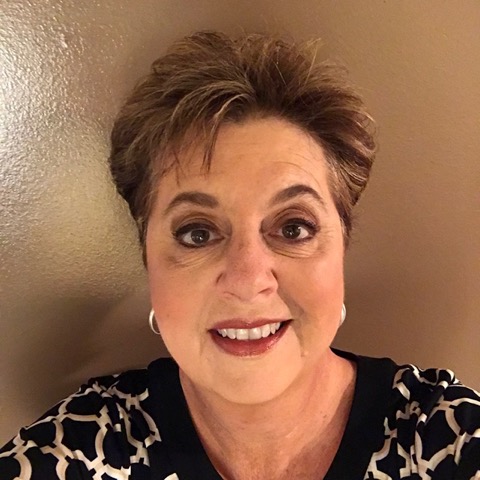
Kathy Carlton Willis, God’s Grin Gal, writes and speaks with a balance of funny and faith, whimsy and wisdom. She coaches others to remove the training wheels of fear and not just risk, but also take pleasure in the joy ride of life. She is known for her debut book, Grin with Grace, and for her grinning Boston terrier, Hettie. Her new book, The Grin Gal’s Guide to Joy is inspiring Joy Sightings everywhere. Learn more about God's Grin Gal.

Graphic adapted, courtesty of Klimkin at Pixabay.

Thursday
Jul092020

I Can Fly with a Little Help from My Friends!

Deb DeArmond loves to see the Lord transform relationships through the wisdom of His Word. In this Friendship UPGRADE, she shares some tips for cultivating stronger friendships.

“In a recent email,” Deb said, “my friend, Jeanne closed with the words, ‘Thank you for being my friend. In the moment, the phrase caught me off guard and my eyes quickly filled with tears.”

I (Dawn) understand the depths of emotion we can feel because of our friendships, and sometimes our poor responses to friends we love. Deb addresses both.

Deb continues . . .

The content of my friend's note was not emotional, and yet I became a puddle without warning. Why?

Jeanne and I met at a writer's conference seven years ago. She invited me to record an interview about my first book, Related by Chance, Family by Choice. It would be broadcast on Heritage of Truth, the ministry she and her husband built together.

Though our time was brief, our hearts made an immediate connection that's grown stronger over time.

  • We can’t meet for coffee; we live 1000+ miles apart.
  • We rarely email and have never spoken on the phone.
  • In a good year, we see each other once or twice.

So why did her expression of friendship impact me so deeply?

It's simple: God made us for CONNECTION.

It stirs us. And heart-to-heart friendship is tough to come by. I believe it’s rare.

We may call many people friends, including co-workers, neighbor, and our regular church companions in the 6th pew back from the stage on the right side of the sanctuary. We may stay in touch with many who date back to childhood.  

I went from kindergarten to college with most of the same kids. They are important to me. We keep up with one another through social media—I know who has a new baby in the family, a promotion, or the loss of a loved one. I’m grateful we grew up together.

  • Are these heart connections? Not so much.
  • Do we all share the same faith? No, and sadly, some have none at all.

But I love them because we were witnesses to one another’s lives.

We have a shared history.

Could I call on them for encouragement, prayer, or a reminder of the God’s love in a time of hopeless despair or spiritual rebellion? With a few exceptions, the answer is no.

Life demands of us. A friend's encouragement or a loving rebuke is needed at times to remind us who He’s designed us to become.

A good friend is willing to do so, comfortable or not.

I’ve been blessed to experience this level of friendship; to have people—like Jeanne—in my life. She’s been a cheerleader, encourager and role mode. She’s open, candid and kind. I’m blessed to be her friend.

We’ve all had fair-weather friends. Those who tell us what we want to hear and when the going gets tough, they get gone.

Some of us may have been that friend on occasion. God’s not impressed with this approach.

The Bible says,

“And let us consider how to stir up one another to love and good works, not neglecting to meet together, as is the habit of some, but encouraging one another, and all the more as you see the Day drawing near” (Hebrews 10:14-15 NIV).

I hear my mom (gone for 20 years) remind me: “If you want a good friend, you have to be a good friend.”

How can we do that? Here are some possibilities.

Tips and Challenges

1. Ask the Lord to Guide Your Approach.

Pray when you feel impatient with a friend who’s in a tailspin—again.

Maybe it’s fear, maybe it’s discouragement, or a lack of faith. Remember, love wins.

Be completely humble and gentle; be patient, bearing with one another in love” (Ephesians 4:2 NIV).

2. Take Inventory.

Be brave and ask your closest friends how you could support or love them better.

Ask yourself, “Do I dispense advice, or do I seek God to discover what He’d like me to share?”

The heartfelt counsel of a friend is as sweet as perfume and incense” (Proverbs 27:9 NLT).

3. Be Brave.

Proverbs 17:17 reminds us, “Iron sharpens iron, so a friend sharpens a friend.”

Lord, give us fearless obedience to You and Your Word. Let us be a channel to lift one another higher.

After all, that’s what friends are for.   

Which of these tips and challenges might help you further cultivate a cherished friendship today?

Deb DeArmond’s passion is family—not just her own, but the relationships within families in general. Her first book, Related by Chance, Family by Choice: Transforming the Mother-in-Law and Daughter-in-Law Relationships explores tools and tips to building sound relationships between mothers-in-law and daughters-in-law. Book #2, I Choose You Today, helps couples strengthen their marriages. Deb's new book on marital conflict, Don't Go to Bed Angry, Stay Up and Fight! was co-authored by her husband, Ron. They live in the Fort Worth area. For more about Deb, visit her "Family Matters" site.

Graphic adapted, courtesy of StockSnap at Pixabay.

Tuesday
Jul072020

As if Chained with Them

Kathi Macias' novels about issues like human traficking, survival in non-Christian surroundings and persecution of Christ-followers have challenged me greatly and encouraged my desire to pray for the persecuted Church. In this Biblical Thinking UPGRADE, she encourages us to consider the persecuted in a more impassioned and involved way.

"The Bible tells us to remember the prisoners—those who suffer for their faith—'as if chained with them,'" Kathi says. "This is more than a call to remember our persecuted brothers and sisters in prayer; and it is also a call to do whatever we can to ease their suffering and strengthen their witness."

Many years ago in college, I (Dawn) was first moved to pray for the Persecuted Church in Russia. I felt their struggle and cried out to God in their behalf. It's a burden that's never left me, and I'm glad to see Kathi opening her heart about it today.

Kathi continues . . .

As a new believer in 1974, I came to view the Church through an "American lens," as if every Christian around the world lived and worshipped in much the same setting and circumstances as I did.

However, after hearing a few guest missionaries speak at our church's evening services, my understanding of the plight of many believers in other countries changed drastically.

In addition, my Bible reading regarding the early Church took on new meaning. I realized it wasn't just first-century Christians who suffered persecution; it was also believers around the world today who suffer unimaginable hardships for no reason other than their faith in Christ.

It was during that time that I read the third chapter of Hebrews—not for the first time since becoming a believer, but for the first time since my eyes were opened to the plight of fellow believers. Verse 13 nearly jumped off the page as I read it over several times:

“Remember the prisoners as if chained with them—those who are mistreated—since you yourselves are in the body also” (NKJV).

Now I have since heard that scripture used in prison ministry, and I don’t discount that, as I too have served in jail and prison ministries through the years and have quoted that verse more than once in that setting.

However, it is obvious from a clear reading of this verse that the author is referring to believers, those who, like us, “are in the body also.” It is also clear that we are to “remember” these prisoners as if we, too, were “chained with them.” What does that mean?

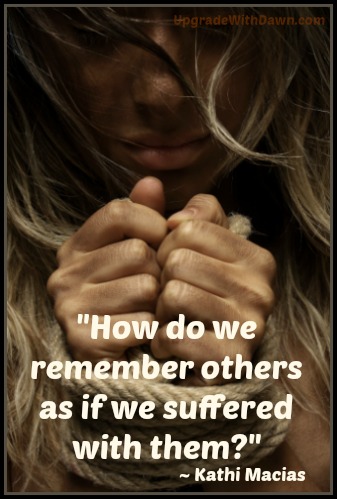
How do we remember others as if we suffered with them?

1. Of course, we must “remember” to pray for them as if we were praying for ourselves (or a loved one) in such dire straits.

I know that if I were the one in chains, I would be in constant prayer and communion with God about every aspect of my situation. And if one of my grown children or grandchildren were being held in such circumstances, that remembrance would no doubt be my last anguished thought as I drifted off to sleep at night, and the first thought when I awoke the next morning.

I would need no reminding or prodding to pray for them; it would flow naturally and regularly from my broken heart.

And that is the type of ongoing, heartfelt prayer God calls us to in Hebrews.

But is prayer enough—even regular, anguished prayer? It is, of course, the first and most important thing we can do for our suffering brothers and sisters in Christ, but can we take it to the next step?

Is there something we can do beyond lifting those “in chains” to God, the only One who can help them?

I believe there is—and I believe we must.

2. Do what you can to ease their suffering.

If, as the verse declares, we are to “remember” our persecuted brothers and sisters in Christ “as if chained with them,” then we need to do for them what we would want others to do for us if we or our family members were the ones in chains. We would want them to pray and also to do what they could to help ease our suffering.

As a result of coming to understand that, I have personally become involved with several worldwide ministries, including Voice of the Martyrs who work tirelessly to assist persecuted believers around the world.

Not only do I receive email updates from them with information on how to pray for certain people, but I also receive their monthly magazine, containing inspirational stories of believers who have stood strong under persecution and seen God’s faithfulness in the middle of it.

Gratitude for prayer is a hallmark of their victorious testimonies.

They also express their appreciation for help received, such as food or clothing or other material assistance.

One of my greatest joys is to know that I help monthly by financially supporting someone who trusts God and goes out to minister in some of the most dangerous places imaginable.

In addition to Voice of the Martyrs, other ministries (i.e., Open Doors, Compassion International) offer opportunities to “remember” those who suffer “as if chained with them.” Working with such ministries is a way for all believers to participate in answering that call.

Not only does such ministry involvement bless and encourage others around the world, it deepens our relationship with the One who calls us to do so.

Are you praying for the Persecuted Church? If not, ask God to move your heart to do so. What ministry to those "in chains" of persecution might you consider today to help you cultivate a heart of compassion for brothers and sisters in dangerous places?

Kathi Macias is a multi-award winning writer who has authored nearly 60 books and ghostwritten several others. Kathi won the 2008 Member of the Year award from AWSA (Advanced Writers and Speakers Association) and was the 2011 Author of the Year from BooksandAuthors.net. Her novel Red Ink won the 2011 Golden Scrolls Novel of the Year Award and was also a finalist for a Carol Award from American Christian Fiction Writers. Kathi “Easy Writer” Macias lives in Homeland, CA, with her husband, Al. You can learn more about her and her books/ministry at www.kathimacias.com.

Graphic adapted, courtesy of Engin Akyurt at Unsplash.